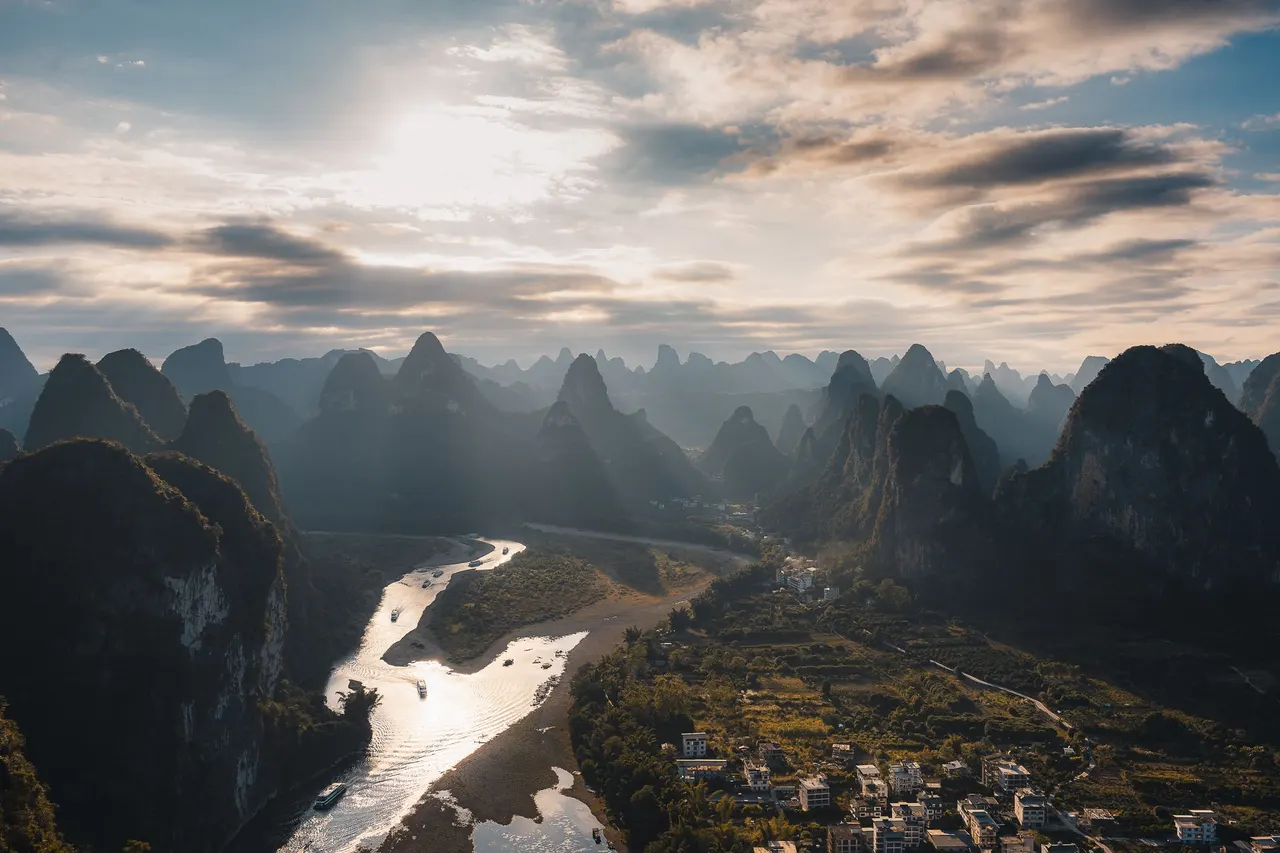
Green peaks mirrored in the water, fishing lights dotting the dusk — the Li River flows from the sky.
The beauty of the Li River is not the scenery; it is what it teaches you about slowing down.
The boat from Guilin to Yangshuo takes four hours, and nobody sleeps. Peak follows peak — one like an elephant, another like a camel — and the river keeps the reflection of every mountain without missing a stroke.
At Xingping old town, dawn belongs to the fishermen. An old boatman poles his bamboo raft, a cormorant standing on the bow. The sun has not risen; a thin mist lies on the water, and the raft glides out of it like a brushstroke from an ink painting.
The Li River is a classic karst landscape. Over hundreds of millions of years, flowing water dissolved the limestone into solitary peaks rising from the plain. The landscape on the back of the twenty-yuan banknote is taken from Yuanbao Mountain near Xingping, and the Nine Horses Hill cliff shows natural patterns that look like galloping horses — how many you count depends on your imagination.
The river is not only scenery but life. Fishing villages line the banks, where elders still fish with bamboo rafts and cormorants; orchards on the islets bear fruit through the seasons, from tangerines in spring to persimmons in autumn. Drifting down the river, you see a river with its own daily rhythm and working people.
Yangshuo is the end of the river journey and the start of another. West Street buzzes with travellers at night, the quiet rafting on Yulong River glides between rice paddies and green hills, and the Ten-Mile Gallery cycling route strings together Moon Hill and the Big Banyan Tree.
Rain gives the Li River another kind of beauty. In drizzle, the peaks hide behind veils of rain and the water ripples softly, turning the world into an ink wash painting; after heavy rain, waterfalls pour from the hills and the air is full of fresh greenery. Locals say a clear Li River is not as beautiful as a rainy one, and a rainy one is not as beautiful as a misty one.
Ancient towns and villages hide along the banks. Xingping keeps its old flagstone streets and arcades, fishing villages nestle white walls and dark tiles, and the ferry stops of Caoping and Yangdi were once stations of river shipping. In the morning, villagers carry breakfast baskets to the riverbank, and cooking smoke rises with the mist.
Guilin city itself is worth a day. Elephant Trunk Hill, the city's symbol, looks like an elephant drinking from the river; the Two Rivers and Four Lakes shine at night as boats pass under bridges and through lights; Reed Flute Cave's stalactites glow under coloured lamps. When locals say the scenery of Guilin is the finest under heaven, they mean the whole city, not just the river.
At dusk in Yangshuo the sky turns from gold to crimson and the peaks become black silhouettes. Someone sings folk songs on the river; the voice travels on the water, bounces off the hills and returns. In that moment you understand why they say Guilin's scenery is the finest under heaven.