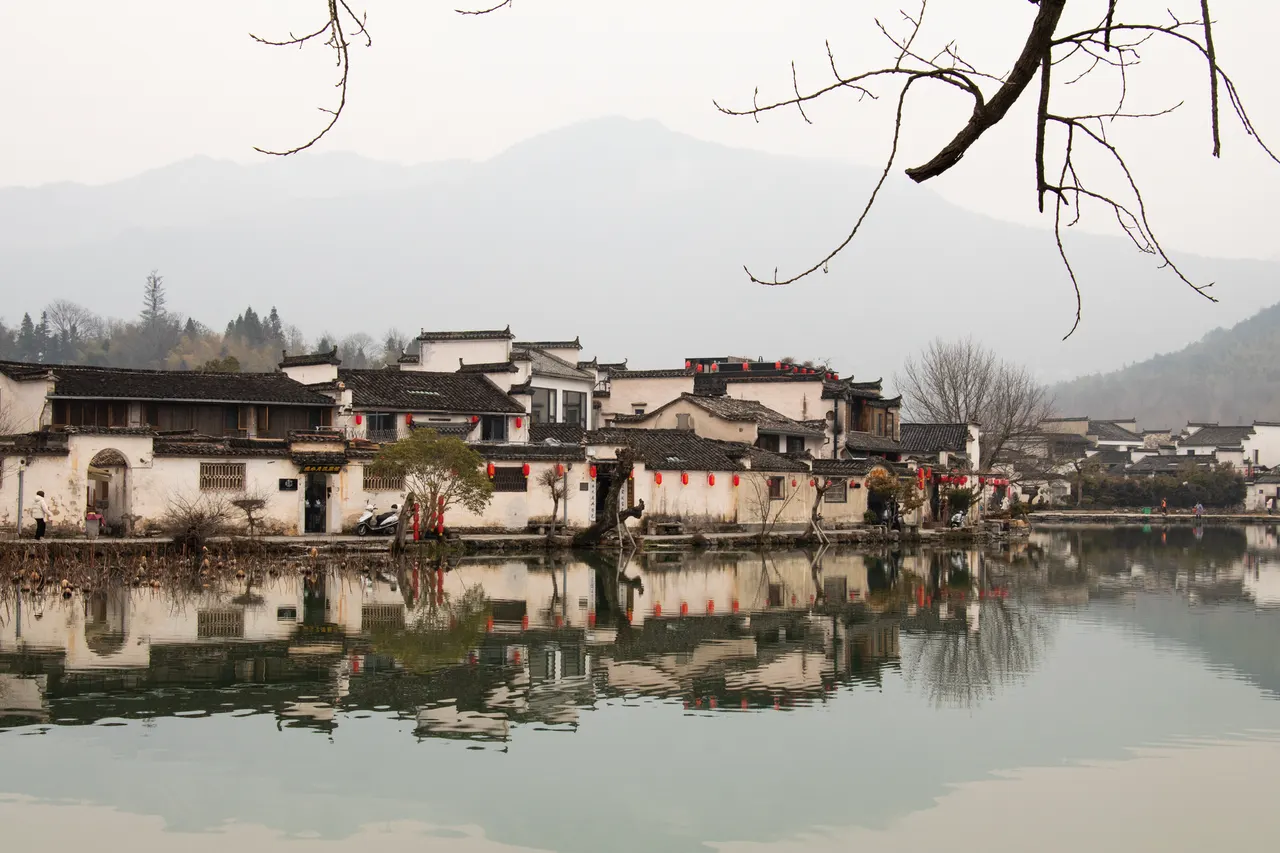
The Moon Pond of Hongcun is a mirror holding white walls, dark tiles and six hundred years of ordinary life.
For the people of Huizhou, homesickness is a pool of water that never dries.
Hongcun begins at the Moon Pond. The water barely moves, gathering every dwelling, hall and horse-head wall into its reflection. Villagers cross the little bridge with baskets, and their shadows break apart and rejoin in the water like a soft stroke of ink.
Here, water has a name. The villagers call it the 'ox-shaped water system' — winding channels that pass every door. Centuries ago, the Wang ancestors diverted water from the West Brook into the village, and since then the water has never grown stale, and life has never ceased. Water gave this village its life, and gave homesickness its shape.
Sitting in the courtyard of an old academy, rain falls from the four corners of the eaves. Huizhou merchants travelled the world and built their finest houses at home, carving them for the village and for posterity. A couplet on the hall reads: 'For generations, nothing surpasses good deeds; the greatest pursuit is reading.' That is wealth more lasting than gold.
At dusk, easels appear around the pond — some paint the reflection, some paint the people. I realized that Hongcun is beautiful not because it looks like a painting, but because it still truly lives: washing by the water, tea in the hall, listening to rain under the eaves. Homesickness, perhaps, is the comfort that everything is still here.