On the murals of Mogao there are flying apsaras, caravans and Buddhist heavens — and a thousand years of Silk Road memory.
Every inch of Dunhuang's walls is a sutra written by time itself.
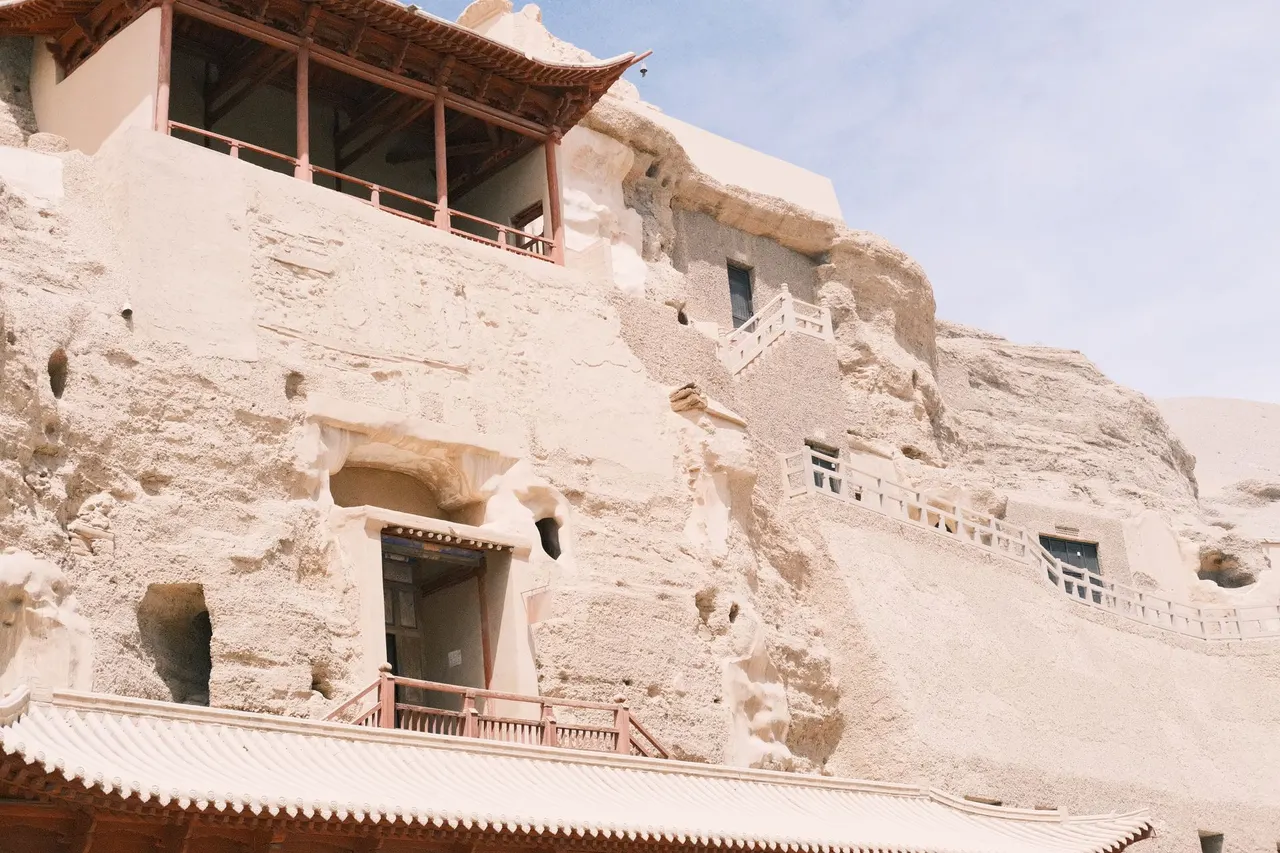
Twenty-odd kilometres southeast of Dunhuang town, the Gobi gives way to a cliff studded with caves like a honeycomb. This is Mogao. In 366 AD, a monk named Le Zun saw a golden light here, as if a thousand Buddhas had appeared, and cut the first cave into the cliff. No one could have imagined that this single cut would begin a thousand years.
Inside the caves the light is dim; a guide's torch sweeps across the walls — flying apsaras, pipa lutes, Hu merchants, camel trains. From the Northern Wei to the Yuan dynasty, painters put both paradise and daily life onto the walls. In Cave 45's High-Tang mural, a merchant meets bandits and Guanyin appears; robes fly in the wind and the colours remain vivid today — because the pigments were ground from gems.
In 1900, the Daoist Wang Yuanlu was clearing sand when he found the Library Cave: more than fifty thousand scrolls, documents and silk paintings sealed for nearly nine hundred years. They were scattered to London, Paris, Tokyo and St Petersburg. Some call it a wound; others say that precisely because they spread across the world, Dunhuang became a global field of study. Today, Digital Dunhuang is moving the murals into the cloud, millimetre by millimetre.
When I left, I stood a long time before the nine-storey tower. Wind blew from the Three Perils Mountains, and sand from the Singing Dunes struck my collar. A thousand years ago, Xuanzang walked this way; a thousand years ago, painters left everything but their names here. What Dunhuang taught me is simple: some things deserve to be guarded for a thousand years.